
An organization has different type of resources but one resource that is pivotal to its growth and development is the human resource (HR). Logically, the use, judicious or otherwise, of all organizational resources (HR inclusive) is determined by human judgement.
Simply put, humans decide the amount of financial resources required to purchase raw materials needed for the construction of physical resources; humans decide the type of technological resources an organization adopts to advance its operations or the informational resources an organization adopts in storing its data. The relevance of the HR initiated this article which focus on the professional body acting as a HR hub, and responsible for the learning and development of people professionals – The Chartered Institute of Personnel and Development (CIPD).
Before proceeding with the article, here is a list of services Craig Educational Consult can provide to assist you through out your CIPD programme.
About CIPD
The Chartered Institute of Personnel and Development is a professional body of human resources (HR); learning and development (L&D); organizational development (OD); and all people professionals. The institute was established over a century ago with the goal of championing better work and working conditions.
As of today, it has supported over 160,000 professionals through its globally dispersed study centres. ICS learn, Avado learning, MOL learn, DPGLearn, and AheadHR are a few of the centres available to help aspiring CIPD professionals achieve their learning goals. These centres are saddled with the responsibility of managing learners course enrolment; setting course fees, delivering the learning content and unit of the assessment; marking the assessment; and answering any arising query.
All study centres’ responsibilities are only possible when their operations is in line with the guidelines laid by the certificate awarding organization, CIPD. For clarity, CIPD outlines the expected syllabus for each qualification; the assessment for the core units of all qualification; and set marking standards expectations which should all be adhered to by study centres. The point here is while HR professionals may be after getting a professional certification, they should also pay attention to the study centre which meets their professional and academic needs.
Qualification Types and Subjects
The CIPD programme is designed to include aspiring HR professionals with different academic backgrounds. Currently, CIPD supports three levels of qualifications. The first is the level 3, also the foundational level which serves as the bedrock upon which HR career is built. It is a qualification for beginners and it grooms participant for a period of 8 to 12 months.
The next CIPD qualification available is the associate diplomas (level 5). Here, people professionals who have graduated from the foundational stage and have burning desire to gather further insights on professional practices that guarantee organizational success enrol. These professionals have the opportunity to earn an Associate Diploma either in People Management or in Organizational Learning and Development. Level 5 completion is 12 to 16 months and successful candidates are awarded the CIPD Associate Member status.
The last, and the highest level of CIPD qualification is the Advanced Diploma or CIPD level 7. This degree is specifically designed for experienced professionals seeking advanced HR skills associated with leadership and strategic roles. Interested professionals can only choose between the Advance Diploma in Strategic People Management or the Advanced Diploma in Strategic Learning and Development certification. The timeline for completing the degree is between 16 to 24 months with successful individuals awarded the CIPD Associate Member status with the possibility of Chartered Member or Chartered Fellow both of which depends of the individual’s experience.
Both Advance Diplomas courses are also made available at CIPD accredited universities and these courses are slightly different from what is made available at study centres. However, they align with the purpose, core behaviours, skills and knowledge associated with being a professional HR.
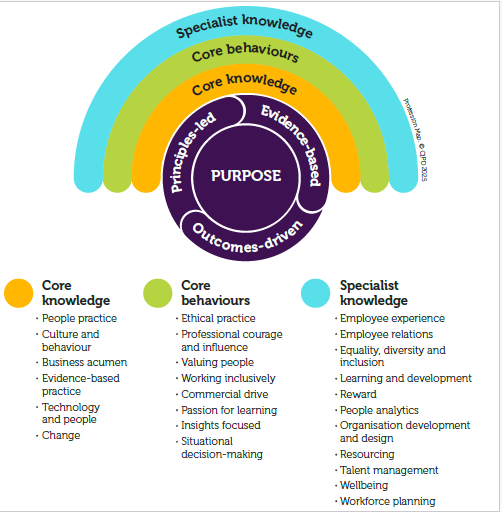
Figure 1: The CIPD Professional Map
CIPD Modules
CIPD courses have several modules designed for different purposes. They are grouped into four types based on the mission they accomplish – Essential insights, Introductory, Developmental and Accredited programmes. Essential Insight CIPD modules are developed to train HR enthusiast on the basic expectation of the HR profession. Introductory modules act as the foundation on which HR knowledge about HR practices are built. Developmental modules help HR professional build specific knowledge and skills to excel in a specific area of practice. Lastly, Accreditation modules enables HR professionals to be impactful
Modules under these categories address issues related to culture and behaviour; diversity and inclusion; employee experience; employee law; human resources; learning and development; organizational development and design; people analytics; people management; recruitment and resourcing; and reward & benefits.
Conclusively, while HR professionals are focused on the CIPD certification from the broader perspective. It is important they pause and examine the programme from the components as discussed in this article. This examination help them know what path would likely work for them and stick with it.
As a university student, if you constantly struggle with any aspect of your academic work (courseworks, assessments, tests, essays, assignments, research, analysis and writings), you can hire a private tutor at Craig Educational Consult to help improve your performance. If you know any student in need of these resources, direct them here.