

1.1. Assess a range of different factors which impact on an organisation’s business and its HR function.
First, it is expedient to note that businesses function as part of a larger ecosystem making them vulnerable to the influences posed by factors inherent therein (Bonnici and Galae, 2015). Though these are just a fraction of the factors that affect business, others lie within the business and are capable of determining the business success and its HR function. In explaining this assessment, we examine Google focusing on the impact of two external and internal factors each observed to affect the organisations business and HR functions.
External factors affecting Google
The two external factors briefly examined are government policies and the labour market
Government policies:
On government policies, due to the fact that most governments do not put up policies that regulates online activities of which the tech giant specialises on, it have been able to carry out business successfully, globally without limitation and formulate local policies that helps builds its community. Censorship restriction in China placed on the company forced it to abandon the Chinese market. It is thus obvious that Google is active in region with little or no government intervention and passive where these regulations are present. This means that the presence of government policies reduces Googles productivity and its absence reduces it. HR on the their hand have to be familiar with the local laws of the country and meticulous in performing their duties in consonance with them so as to avoid misconducts that can result in sanctions and fines.
2.1 Analyse the forces shaping the HR agenda.
Previous perception held towards human resources revolves around been a centre which incurs cost or one with a short lived focus on gains and savings, mostly because, organisation tend to expend more through investment on its talent intangibles (Guthridge et al, 2008). The HR of modern day is set to change these opinions with their intents now fashioned to accommodate achieving long term organisational objectives and diversifying from solely involving in human resources related issues to accepting broad challenges in meeting the set task. According to Ulrich (1996), a modern day HR is expected to be a strategic business partner, change agent, employee champion and administrative expert. However, these have been greatly dictated by certain forces such as globalisation and climate change.
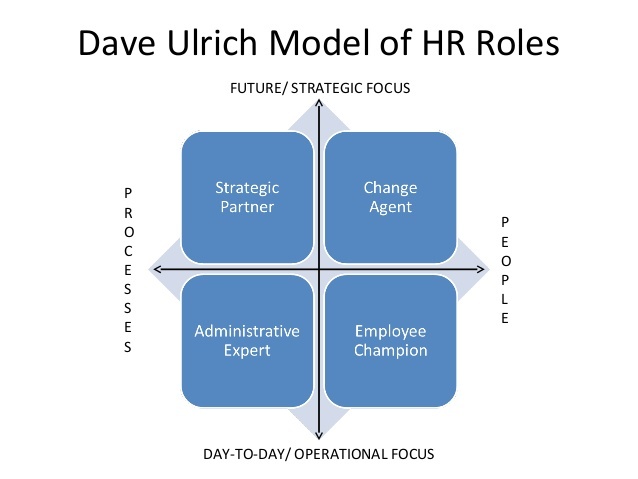
Figure 1: Ulrich model of HR roles
Source: Ulrich (1996)
2.2 Compare different tools for analysing the business
Bonicci and Galae (2015) opined that organisation engage in businesses as part of a broader environment. They further stated that there is a presence of different external factors often beyond organisation’s control which impacts its businesses. In order survive the threats pose by these factors, there is a need to carry out an in-depth analysis with aim of developing preemptive strategies that dovetails perfectly into mitigating the impacts of these external factors on businesses. BNET Business Dictionary (2007) refers to this analysis as “strategic analysis” and defines it as a process of conducting research on the business environment in which an organisation operates and the organisation itself so as to come up with a strategy. The Chartered Institute of Management Accountants (2007) outlined seven analytical tools that can be used in strategic analysis and they include: PEST analysis, SWOT analysis, Porter’s five forces analysis, Value chain analysis, early warning scans and war gaming. PESTLE analysis and Porter’s five analysis will be discussed in this assessment.
PESTLE Analysis
PESTLE is an acronym that depicts the Political (P), Economic (E), Social (S), Technological (T), Legal (L), and Environmental (E) factors affecting businesses. Sometimes it comes in different variants such as STEEPLE with an extra ‘E’ denoting Ethics or STEEPLED with the ‘D’ denoting demographic factors. The analysis generally helps organisation identify opportunities and threats lucking about in their external macro environment.
2.3 Explain the key stages in strategy formulation and implementation and the role of HR.
Porter (1996) stated that having a strategy gives an organisation a unique position which distinguishes them in a competitive arena. Based on the sector, whether an organisation is public, private or non profit, different scholars and global bodies have contributed in one way or the other in developing methods for attaining effective and efficient strategies. Tapera (2016) stated that developing a strategy for a business involves 5 stages which are developing a strategic vision, setting objectives, developing actual strategies, implementing and execution of approved strategies and evaluating performance. In contrast, World Bank (2011) came out with an eleven steps process of strategy formulation for nonprofit organisation. They include agreeing to strategy planing process; undergoing environmental scan, identifying strategic planning issue; developing value, mission and vision; developing organisational vision, developing organisational status statements; developing strategies; developing annual plans; summarised the developed strategic plans and developing a monitoring and evaluation plan. For the sake of this assessment, the key stages developed by Bryson (1988) for both public and nonprofit organisation would be discussed as it is a concise version of the World Bank (2011). He stated strategy formulation involves seven stages.
The first stage is the development of initial agreement. Before embarking on strategy formulation, parties involved need to unanimously commit to the process and this must be in all spheres. Parties must have a similar view on issues like the need for the strategy, roles and membership of both the strategy formulation committee and strategy planning team and necessary resources for the process to mention a few. The role of the HR personnel at this stage centre on spotting the cogent need for developing a strategy and communicating it to all involved stakeholders.
2.4 Examine HR’s contribution to the business ethics and accountability.
Although general ethics have been long studied since the ancient times, interest in business ethics have not lived beyond five decades, and the attention given to it in recent times was reignited by the rising rate of business scandals which ranges from the Enron to the Parmalat disaster (Carroll, 2004). Letendre (2015) defined business ethics basically as the ethical study of everyday practise in which business values expressed in fairness, compassion, integrity, honor and responsibility are exhibited in business structures and behaviours. However, Purcell and Weber (1979, p. 6) gave a more comprehensive definition of the concept as presented in their quote below.
“Institutionalizing ethics may sound ponderous, but its meaning is straightforward. It means getting ethics formally and explicitly into daily business life. It means getting ethics into company policy formation at the board and top management levels and through a formal code, getting ethics into all daily decision making and work practices down the line, at all levels of employment. It means grafting a new branch on the corporate decision tree — a branch that reads “right/wrong””.
Brooks (1989) as seen in Salehi et al (2012; p3) highlighted a list of areas organisation should consider being ethical about. They include employee’s conflict of interest, inappropriate gifts to corporate personnel; sexual harassment; unauthorized payments; affirmative action; employee privacy; and environmental issues.
3.1 Evaluate business performance and the role of HR in business planning and the change management agenda.
Though many businesses do great when it comes to developing strategies, their pitfall lies in the inability to monitor and control them. Greater sustainability would be attained as long as developed strategies are matched against organisational goals. The latter shed light to the concept of Business performance which according to Neely et al (1995) refers to a set of metrics used in quantifying the efficiency and effectiveness of business actions. While efficiency refers to the ratio of relevant outputs to input, effectiveness talks about the extent to which an organisation is producing the desired results. Ireland et al (2011) listed eight business performance measurements that can be adopted by modern day businesses. They include Balance scorecards, Benchmarking, Business process reengineering, ISO9000, Knowledge management, management by objectives, total quality management. For the sake of this assessment, three business performance model will be discussed.
The total quality management (TQM) model was developed in the 1980s as a comprehensive philosophy and it operates on the continuous improvements of products and services so as to come up with a better version that would bring more satisfaction to the end users (Hill, 2008). In-depth analysis by Besterfield et al (2003) explains that the “total” refers to “made up of the whole” pointing to the totality of the organisation; Quality refers to the degree of excellence a service or product provided by the organisation; while management points to the act, art, or manner adopted when handling, controlling and directing.
3.2 Assess and utilise different sources of business and contextual data for planning purposes.
Business data can either be primary or secondary, quantitative or qualitative (Taylor and Woodhams, 2016). Horn (2012) explained that Primary data are information collected specifically for a study in which they are used while secondary data are those extracted from previous studies. On the other hand, Bryman and Bell (2015) differentiated between qualitative and quantitative data. They posits that qualitative data are information that involves words and meanings rather than collection and analysis of numbers, while quantitative is the vice versa of qualitative data. Horn (2012) further stated that the academic literature are the most important source of data and they can be accessed through both physical means (mostly public, private or university libraries) or online sources academic journals like EBSCO, Emerald, Google Scholars. Information from professional associations’ websites like The Chartered Institute of Personnel Development have also proven to be useful for planning purposes.
When planning, HR professionals need to be familiar with certain data. for instance, financial data of the organisation are essential for the planning and strategy implementation.