

Introduction
A lot of times, confused students having difficulties with an assignment or a coursework and needing assistance with their education, ask for help on students’ forums, such as Quora or search engines sites like Google. These students adopt different approaches while seeking assistance. Figure 1 and 2 are examples of the different approaches students from different disciplines/Universities adopt when seeking academic help. This article aims to examine the concept “academic help,” determine the forms in which help is given to students in need and ascertain whether getting help as a student is punishable.
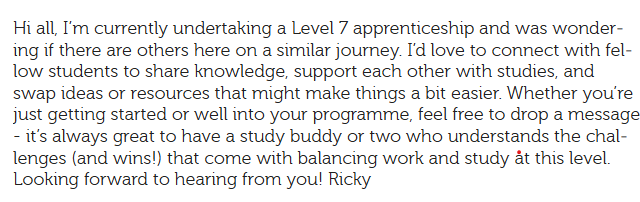
Figure 1: A CIPD level 7 student in need of academic help.
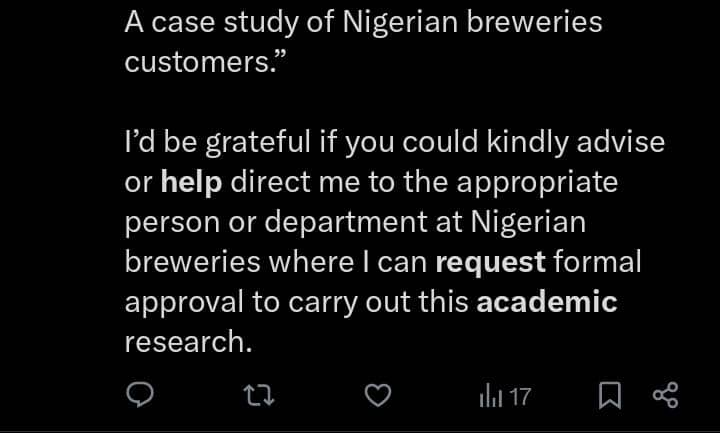
Figure 2: A student on X (formerly twitter) sought help regarding his academic research on the x platform.
What is Academic Help?
To begin, it is important to state that the term “Academic Help” is synonymous with “Academic Support.” Simply defined, Academic Help are educational programs and strategies implemented to assist students achieve excellence in their education. It is important that students seek this help when needed in order to boost their academic standing. In a way, it points out that the involved student is really interested in learning. Scholars Karabenick and Berger (2013) classified students’ ability to seek for academic help into two. They are the executive and instrumental help seekers. The executive (also referred to as expedient) describes students who seek help that excludes their involvement. These types of students are only interested in the result and show little to no interest in the processes that bring about the result. On the other hand, the instrumental (also known as the adaptive), are students who seek only the help that is required to complete their assessment(s) themselves. The latter do not want to leave the processes involved to the party giving the help. These students are interested in knowing the processes associated so that they can carry out the task themselves or subsequently when faced with similar challenge in the future.
Before proceeding with this article, take a look at the academic help services Craig Educational Consult offers.
Forms of Academic help
Several ways exist in helping students achieve excellence in their academic. While some of them are active (that is, involve the direct participation of students), others are passive (that is, involve little or no effort from the students). One of the most recurring active academic help is tutoring which is defined as a continuous, systemic pedagogical approach with the goal of improving students’ personalities, academic performance; and professional perspectives (Quiroga & Padilla, 2014). As usual, tutoring takes place between an academic expert (teachers, lecturers, & Professors) and the students. In more recent settings, tutoring can occur among students who share similar educational qualifications. This type of tutoring is known as peer tutoring and it encourages the balanced distribution of knowledge among students. Another familiar form of tutoring is the Adult Tutoring which involves an adult educator experienced in a field operating within the university or outside and disseminating academic knowledge to student.
Another approach to providing academic help is through mentoring. It is a process whereby students work closely with mentor(s) which provide extra academic exposure that helps students build self-esteem, encouragement and self-efficacy necessary to perform better academically (Peterson et al, 2014). Mentoring takes place between two parties – the Mentor and the Mentee. While the association between these parties have been reported to be mutual, the mentor contributes higher as they exert more influence on the mentee through various actions like sponsoring, supervising, on-boarding, advising, counseling, and consulting (Crites et al., 2022).
Importance of Academic Help
The forms of academic help discussed above show that seeking academic help is not something that deserves being punished/penalized on. Almaghaslah and Alsayari (2022) study provided an insight on reasons students consider seeking academic help. Seeking Academic help prevents students from failing in their academic pursuit; assist students in developing and improving in their learning; and motivating students to enroll and engage better in the academics. In addition, several studies reported a direct correlation between student asking for help with their academics and improved academic performance; enhanced learning experience; increase self-confidence; improve transitioning into higher education. Conclusively, seeking academic assistance is not a punishable offense and should be an act that should be encouraged among learners.
As a university student, if you constantly struggle with any aspect of your academic work (courseworks, assessments, tests, essays, assignments, research, analysis and writings), you can hire a private tutor at Craig Educational Consult to help improve your performance. If you know any student in need of these resources, direct them here.
References
Almaghaslah, Dalia & Alsayari Abdulrhman (2022). Academic Help seeking behaviours of undergraduate Pharmacy Students in Saudi Arabia: Usage and Helpfulness of resources. Healthcare. 10. 1264.103390/Healthcare10071264
Crites G. E, Ward W. L, Archuleta P, Fornari A, Hill S. E, Westervelt L. M, Raymond N. A (2022). Scoping review of healthcare faculty mentorship programs in academia: Recommendations for success. Journal of Continuing Education in the Health Professions.;24(1):1555435. doi: 10.1097/CEH.0000000000000459.
Karabenick, S. A.; Berger, J. (2013) Help seeking as a self-regulated learning strategy. In Applications of Self-Regulated Learning across Diverse Disciplines. A Tribute to Barry J. Zimmerman; IAP Information Age Publishing: Carlotte, NC, USA, pp. 237–261.
Peterson, Reece L.; O’Connor, Ann; and Strawhun, Jenna, (2014). “Academic Supports & Tutoring”. Special Education and Communication Disorders Faculty Publications. 236
Quiroga, L. A., & Padilla, M. A. (2014). El concepto de modo lingüístico y
su aplicación en los procesos de enseñanza-aprendizaje mediante las
TIC´S. Journal of Behavior, Health & Social Issues, 6(1), 9.
https://doi.org/10.22201/fesi.20070780.2014.6.1.48518