

Several times, students about to commence their final-year projects are prone to ask for the “dissertation format” considered as appropriate. Mostly, this particular query may stem from students studying courses with philosophies rooted in different disciplines. A dissertation, sometimes referred to as “Thesis”, “Project work” or “Research project” is that compulsory investigation into any subject area of interest conducted by students (undergraduates and post graduates) and documented for the assessment and reference of others in academia.
Personally, from a holistic viewpoint, the ideal “dissertation format” should be a function of the higher institution awarding the degree. When narrowed down, the discipline awarding the degree should decide the format expected of its students. Having established this, students with such queries should be directed to consult their departmental guidelines and strictly adhere to the recommended format.
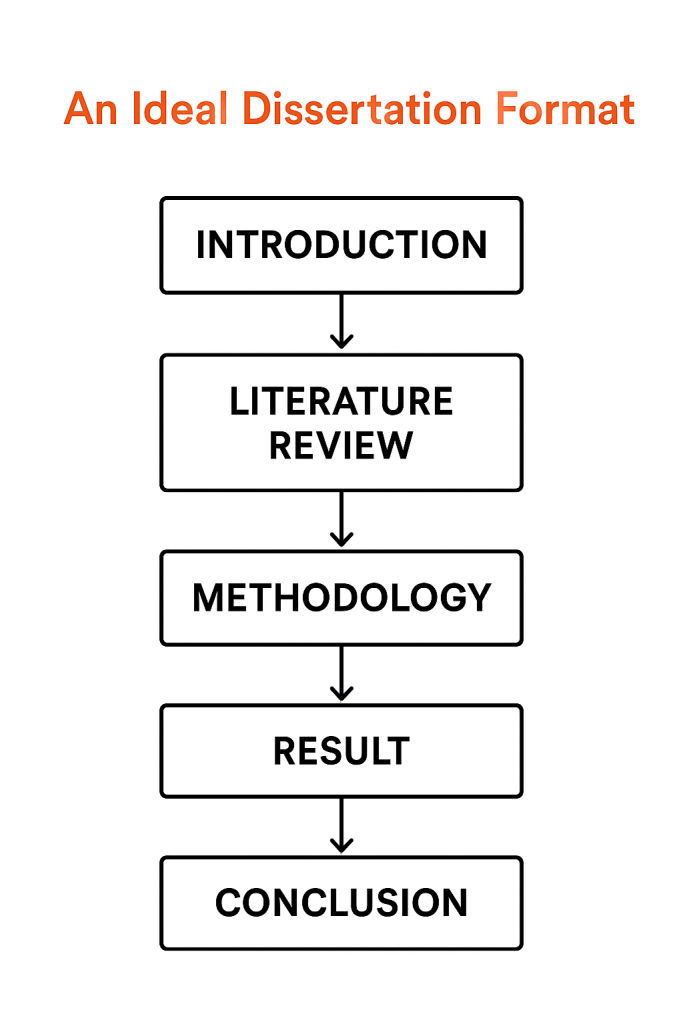
Figure 1: An ideal Dissertation Format
Before proceeding, take a look at the list of services Craig Educational Consult offers in order to assist you develop an ideal dissertation.
In situations whereby there is no stipulated format given, curious students can stick with the format discussed in this article. The idea behind this format is anchored on the fact that since dissertation is a documented investigation, it is expected to involve certain processes. These processes make up the format. Starting with the INTRODUCTION, students have the privilege to tell readers about the nature of their investigation. Here, students enlighten the audience on whether the issue being addressed is social, economic, technological or health related.
The gravity of its occurrence is evaluated, correlated with its impacts and presented, supporting claims with statistics from reputable sources. In this section, students can migrate from the broader view, focus on their own particular interest in the grand scheme of things and enlighten readers on the necessity of their focus. Defining objectives and stating hypotheses (if any) are also components of this section. Finally, students can explain to the audience what they should expect by mapping out their study.
The second process is the LITERATURE REVIEW. A dissertation is not all about random write-up to justify an objective or hypothesis. It is for the most part built on the foundations laid by previous scholars with the goal of advancing an area of interest. Students have to create a section in their dissertation to review scholars’ opinions about the subject of discourse. The review could be in the form of concepts which are unique ideas, themes or aspects; theories, which are logical framework that explains the association that exist between observed concepts; and studies which are previous publications having some kind of similarities with the current study. While reviewing, students should analyse, synthesize and critically evaluate all concepts related to subject under study.
Thirdly, replicability is a prominent quality of a good research. It allows others in the field to reproduce a research seamlessly whenever and wherever. This particular quality creates the next process of a dissertation format which is the METHODOLOGY. In the section, the researcher documents all the scientific details required to reproduce the study. It includes the approaches adopted by the student in collecting, analysing and interpreting the data collected in the study.
Aspects of this section includes the research design, study area, target population, sampling procedures, data collection instruments, data analysis, and ethical procedures. Depending on the type of research, whether it is a qualitative or quantitative research, aspects like research design, data collection or analysis differs. For instance, while data for qualitative studies are collected using focus group discussions, data for quantitative studies are obtained using questionnaires.
The next process is the RESULT. In the section, students are expected to present every information derived from the data collected and analysed. Whether the information presented is descriptive or inferential, students must ensure that they explicitly answer the research questions, objectives and hypothesis highlighted at the introductory section of the dissertation. Basically, students present factual findings in texts, graphs and tables.
Ammon (2022) provided an insight to how students should present this section which is having an introductory context, followed by the important findings (relevant findings in a quantitative study), then the interesting findings (significant findings in quantitative studies), and the summary of the key findings. At other times, this section could also include discussions on what the finding represents.
Finally, the last process involved in conducting a research is the Conclusion. It gives a brief overview of the study’s achievements and may further spark curiosity about areas that can be explored based on the findings..
Conclusively, an ideal dissertation format must contain the following in this order – Introduction, Literature Review, Methodology, Result, and Conclusion and Recommendation. So if as a student, you are at a period where this is the question you are asking, I hope you find this helpful.
As a university student, if you constantly struggle with any aspect of your academic work (courseworks, assessments, tests, essays, assignments, research, analysis and writings), you can hire a private tutor at Craig Educational Consult to help improve your performance. If you know any student in need of these resources, direct them here.
References
Ammon, C. (2022). Result section of research paper.