

1.1 Evaluate what it means to be an HR professional with reference to the CIPD’s HR Professional Map.
The Human Resource Management just like every other public service professions requires its professionals to be accountable to standards of public interests above the compensations derived by clients (Cheffers & Pakaluk, 2011).
1.2. Range of values and Knowledge and their importance.
HR professionals are expected to possess certain value system and knowledge that will assist them perform efficiently and effectively in their profession. Taylor and Woodhams (2016; P174) opined that HR professionals should aspire to acquire this knowledge and adhere to their defined value systems as they are essential in helping them manage themselves; manage teams within their organisation, manage upward and manage across the organization.
1.3 Purpose of Professional Map
Inyang (2008: 53) stated that achieving corporate excellence in organizational setting is a product of human resources capacity building – a long term investment on human resources which exist in the form of training and development. As HR professionals saddled with responsibility of building human resources continually, there is a need to set out in details the necessary competencies needed by HR to perform optimally.
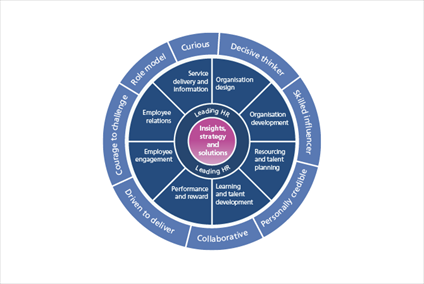
Figure 2.1: HR Professional Map (Chartered Institute of Personnel and Development, 2013)
2.1 What is a Team?
Before addressing the elements of group dynamics, a knowledge of the concept of group (often use interchangeably with the term “team” as seen in most literature) and group (team) dynamics would be a good spot to start. Gencer (2019: P223) defined a group as a formation with a least two people bounded together with a purpose, communicate with each other, affect each other and dependent on each other.
2.2 What is Team dynamics?
Group dynamics on the other hand is conceptualized based on five domains – They are communication process and interaction patterns; interpersonal attraction and cohesion; social integration and influence; power and control; and culture (Toseland and Rivas, 2001). Toseland et al (2015) defined group dynamics as the forces that emerges and forms as members of a group interacts in the life of a group while Cartwright and Zander (1968) defined group dynamics as a set of behavioural and psychological process that occur within a social group or between groups. Both definitions points out the emergent of unconscious forces once there is an interaction between two or more individuals. The latter author however opined that these forces are observable among groups as they are within groups.
2.3 Thomas Kilmann Method of Conflict resolution.
Sometimes ago in my work place, there arose an urgent need of increase production beyond the usual quarter in order meet a client demand for a week. Daily production requires a team of 8 members and a team manager (TM) to work from 5am to 6pm with one hour for recess – this urgent task means there would be an extension of the normal work hours which could also result in employee working throughout the night. Most employees were reluctant to accept this development obvious in the muttering and nagging experienced during the day job.
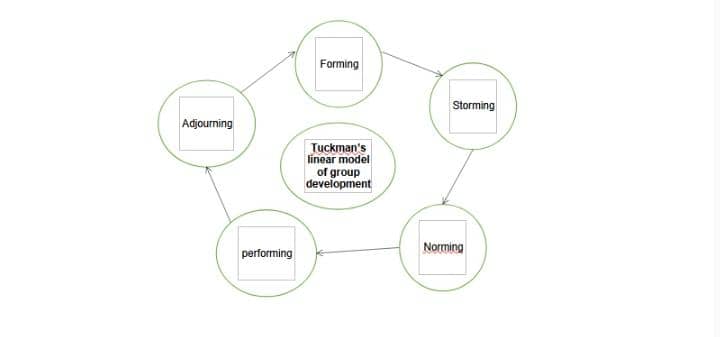
Figure 2: The stages of Tuckman’s model
(ecampus ontario, 2018)
2.4 Workplace Justice
Sometime ago, members of my team felt management are very exploitative most especially when they appear to perform activities outside the scope of their duties. This resulted to sabotaging productive activities in the organization by employees.
3.1 Definition of Project Management and your Project
HR professionals frequently find themselves in different kinds of projects they have to manage whether big or small hence HR have to be familiar with what the term “project management” means. First of all, a project according to Kerzner (2015) can be defined as a series of activities and tasks that have a specific objective to be completed within certain specification, bounded by a time frame; possess a funding limit; requires finance, human and machines and are multifunctional. Project management is the application of knowledge, skills, tools and techniques to a broad range of activities in order to meet the requirement of a particular project.
3.2 Brainstorming
3.3 The Five whys
3.4 Influencing, Persuading and Negotiating
4.1 what is Continuous Professional Development (CPD)?
Several definition abound for this subject matter. While earlier scholars like Madden and Mitchell (1993) define Continuous Professional development (CPD) as the maintenance and enhancement of knowledge, expertise and competence of professionals throughout their career based on a plan developed with regards to the need of the professional, employer, the professional and society.
4.2: Self assessment and options to address developmental needs